0.3 microns, slowly: what an H13 filter actually catches
The fan is not the machine
A purifier is a fan. The filter is the machine. The fan only decides how often the room's air passes through the stack. What comes out the other side is decided by three layers, and each has one job it does well and several it cannot do at all.
We design the purifier section around this distinction. The TZ-K2 draws air in at one end, pushes it through a framed cassette that holds nylon, paper, and carbon, and exhausts it at the other. The fan has its speeds and a sleep setting for the smallest hours. But the fan only moves the air; what leaves the machine is decided inside the cassette.
If you run the unit in a sealed room, the particle count drops not because the fan is clever, but because every pass through the stack removes a fraction of what is suspended in the air. That fraction is measurable. It is also limited. Three stages, one standard at 0.3 microns, one 6,000-hour clock: each deserves its own stretch of honesty.
Three layers, three jobs
The replacement cassette for the TZ-K2 is a single frame that holds three distinct media. You cannot separate them. When the indicator light comes on, you swap the whole unit. But the physics inside are worth separating mentally, because each stage protects the next and each has its own maintenance logic.
| Stage | What it takes out | How you maintain it |
|---|---|---|
| Nylon pre-filter | Large particles | Washable, rinses under a tap |
| H13 layer | Particles down to 0.3 microns | Replaced with the frame |
| Activated carbon | Odors and some gases | Replaced with the frame |
The nylon mesh faces the intake. It stops hair, lint, and coarse dust that would otherwise clog the pleated paper behind it. The layer comes out and rinses under a tap, which extends the life of the stages behind it. Without this first screen, the H13 layer would cake with large debris and choke the airflow, raising the noise level and lowering the volume of air cleaned per hour.
The H13 layer is the pleated paper stack. This is where the 0.3 micron rating lives. The paper is folded into deep pleats to pack surface area into a small volume. The carbon layer sits last, a thin bed of activated charcoal that adsorbs volatile organic compounds and odors that pass through the paper. It does not catch particles. It catches gases. Once its surface area is saturated, it stops working. That is why the whole frame must be replaced even if the paper looks clean.
The 0.3 micron standard
The Environmental Protection Agency defines HEPA filtration with a specific number. According to the EPA, a HEPA filter can theoretically remove at least 99.97 percent of airborne particles at 0.3 microns. You can read the full definition at their guidance page.
Why 0.3 microns? That size is not the smallest particle the material can trap. It is the most penetrating particle size, the point where physics makes interception hardest. Particles smaller than 0.3 microns move erratically and collide with fibers by diffusion. Particles larger than 0.3 microns have enough mass to be captured by impaction and interception. At exactly 0.3 microns, the mechanisms are weakest, so the standard is set there. If a medium stops 99.97 percent at its weakest point, it stops more everywhere else.
The TZ-K2 carries H13 grade media. The claim is not a sterile room; the claim is that any particle that touches the paper and is 0.3 microns or larger has a 99.97 percent probability of staying there. The catch is the word "touches." A particle that floats around the pleats never touches. That is why the fan speed matters. Higher speed means more passes per hour, which means more chances for contact. Lower speed means quieter operation but slower reduction of particle counts.
What we watched in the chamber
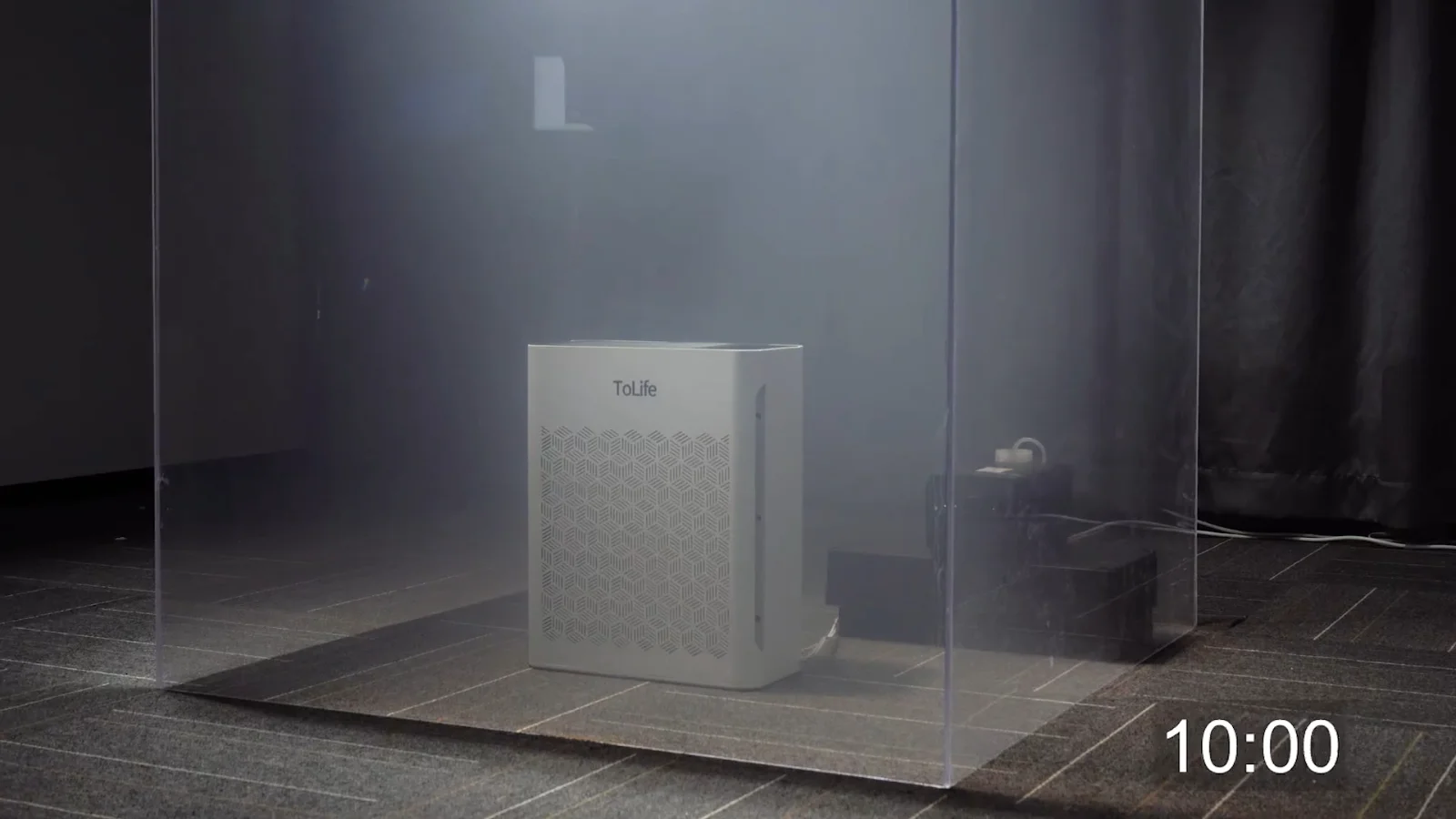
We built a sealed transparent case large enough to hold a running TZ-K2 and a visible haze of smoke. A clock ran in the frame the entire time. The smoke was not special theatrical fog. It was particulate matter suspended in air, the kind of visible pollutant that makes air quality visceral. We did not control for temperature or humidity in a laboratory sense. We simply turned the machine on and filmed.
By the ten-minute mark, the haze had visibly thinned. The case walls, obscured at the start, were back in view before the clock reached twenty-four minutes. We filmed this as the smoke test. The video is not a laboratory certification. It is simply a record of what happened when our machine ran in a sealed box full of smoke. The paper trapped the particulate. The carbon dulled the smell. The fan kept the air moving until the visibility returned.
The test is the argument for patience. The machine did not snap the case clean in thirty seconds. It took nearly half an hour to clear a volume small enough to fit on a workbench. Scale that up to a bedroom, and you understand why we rate the unit for a room rather than a house, and talk about passes per hour rather than instant purification. The filter works by probability over time, not by force.
The honest boundaries
No portable air cleaner removes every pollutant. The EPA is clear on this point. According to their guidance on air cleaners in the home, portable air cleaners reduce indoor pollution but cannot remove all of it. Source control and ventilation come first. Filtration works alongside them.
There are specific things the TZ-K2 stack cannot do. It cannot remove gases that the carbon bed has already absorbed. Once the activated carbon is full, it stops taking more. It cannot remove particles that have already settled into carpets, upholstery, or bedding. Only a vacuum or wet cloth can do that. It cannot remove moisture from the air. For that you need a dehumidifier; that is the other half of what we build. See the 95-ounce question for our writing on humidity control.
Most importantly, we promise no health outcomes. The machine moves air through paper and carbon. It is not a treatment for asthma, allergies or any medical condition, and a persistent breathing problem belongs with a physician. We are engineers, not doctors.
The purifier also cannot work silently at high speed. We publish decibel figures for a reason. If you need silence, you use sleep mode, which slows the fan. We wrote about this trade-off in quiet as a spec. The quieter the setting, the fewer air changes per hour, the slower the room cleans.
The arithmetic of replacement
Everything that enters the stack stays there until you throw it away. The nylon can be rinsed, but the paper and carbon are consumables. The frame is rated for 6,000 hours of operation. The math depends on how you run it.
If you run the purifier eight hours a night, the filter lasts 750 nights. That is roughly two years of sleeping with it on. If you run it around the clock, the same filter lasts 250 days, about eight months. The TZ-K2 tracks this internally and lights an indicator when the hour count approaches the limit.
The replacement part costs $19.99 for a single frame or $29.99 for a two-pack. The two-pack brings the unit cost to fifteen dollars per filter. You can find them in the filter cards.
The whole cost sits in plain view. The purifier is $89.99 once, or $69.98 in white; the cassette is the only part you ever buy again. At eight hours a night a frame retires roughly every two years, which prices the filtration at well under a dollar a month. The variable is your schedule, nothing else. We update our figures on our updates page, but the arithmetic has held steady since we launched the line.
Choosing between the two
The TZ-K2 comes in two configurations. The black unit sells for $89.99 and includes an auto mode driven by an air-quality indicator that shifts green-yellow-red. It also includes a child lock and the full suite of timers.
The white unit sells for $69.98. It removes the indicator lights for dark bedrooms where any glow is disruptive, and keeps the washable pre-filter, the sleep mode, and the same timers. The auto mode and the colour-shifting indicator stay with the black shell.
Both use the identical replacement filter. Both achieve the same 0.3 micron retention when the cassette is fresh. The choice is between automation and darkness, between a machine that adjusts itself and one that stays invisible in a blacked-out room.
What owners report
We have 14,251 published owner ratings across the range. Two of them put the filter in rooms you can picture: an RV that lives on dusty roads, and a thirty-year-old house that sheds dust into every corner.
"I bought this for my RV that is seemingly always dusty. This had helped tremendously with filtering the air."
"My home is 30 years old and constantly dusty. The purifier and this filter have improved the air quality and there seems to be less dust settling."
Both owners note the reduction in dust. Neither claims a medical cure. The first describes a small, sealed space, an RV, where the air changes happen quickly. The second describes a thirty-year-old house with chronic dust load. In both cases, the filter is doing exactly what the specifications predict: removing particles that are suspended in the air before they settle. It will not remove the dust already on the shelf. It catches what is floating.
Reading the room
The TZ-K2 is one part of the ToLife lineup. We have made quiet air machines since 2022, nothing else. The promises here are measurable: 6,000 rated hours, 99.97 percent at 0.3 microns, and a sleep mode that holds the lowest fan step.
If you are deciding whether to buy, consider the room size, the existing dust load, and whether you prefer the black unit's auto mode or the white unit's darkness. Consider the replacement cost, fifteen dollars per filter if you buy the pair. Consider that you will need to vacuum less often, but you will still need to vacuum.
The physics of filtration do not change. The figures can, and the day they last moved - prices and availability, mostly - is printed on our updates page rather than scattered through these paragraphs.
What we read before writing this page
- US Environmental Protection AgencyAir Cleaners and Air Filters in the Home · Portable air cleaners reduce indoor air pollution but cannot remove every pollutant; source control and ventilation come first, filtration works alongside them.
- US Environmental Protection AgencyWhat is a HEPA filter? · HEPA is a pleated mechanical filter that can theoretically remove at least 99.97 percent of airborne particles at 0.3 microns; the rating differs from MERV.
Each document above was read in full on August 27, 2026; the reading dates for every page live on our updates page.